Amsterdam and Brussels: A One-Week Rail-Friendly Plan
A week divided between Amsterdam and Brussels can provide two contrasting city stays without a car. This original example uses four nights in Amsterdam and three in Brussels. It protects the rail-transfer afternoon and treats additional Belgian towns as optional replacements for city time. Before booking, compare the exact international rail product and the stations used; different services and fares can offer very different levels of flexibility.
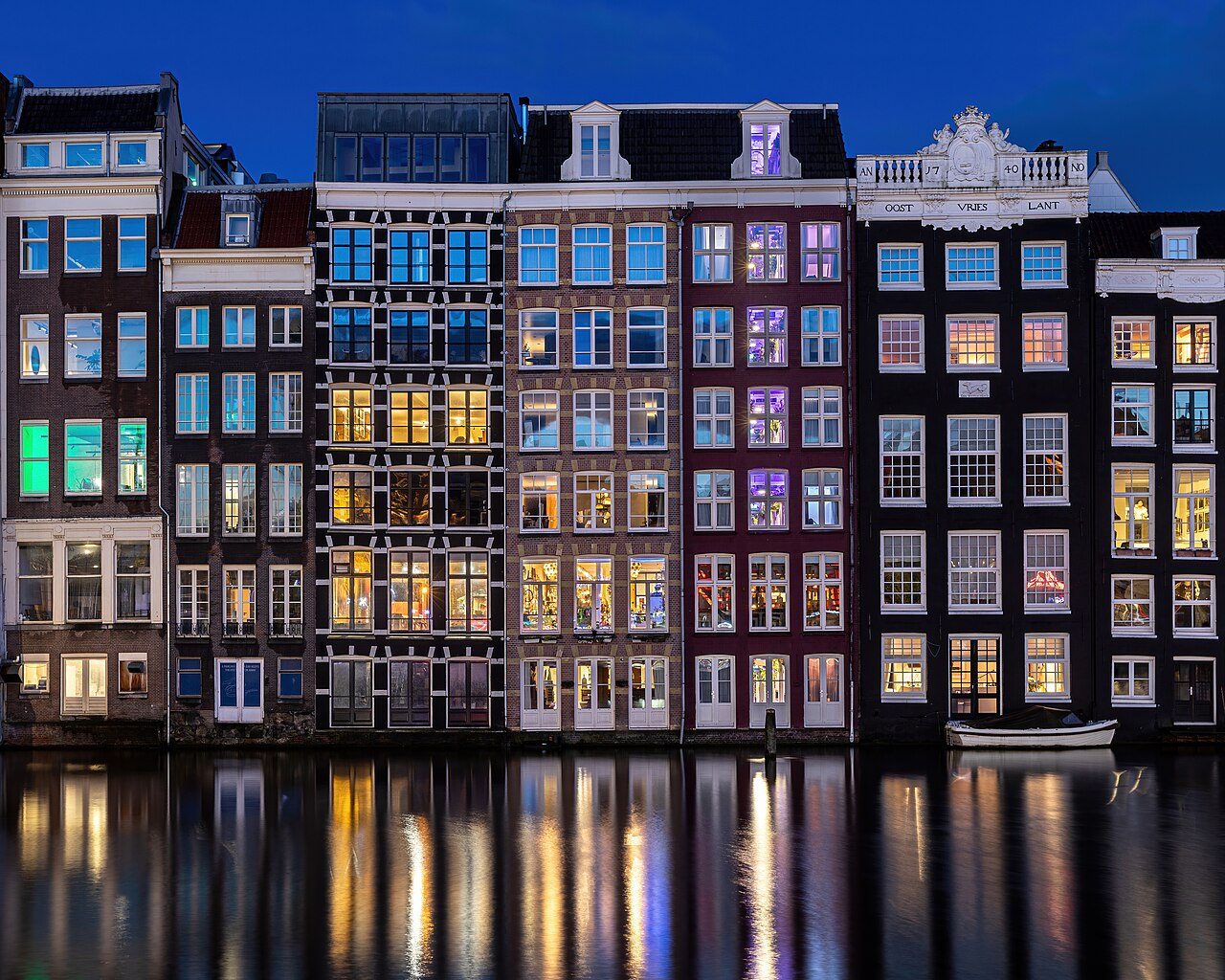
Photo: Basile Morin · CC BY-SA 4.0. Reference photograph: Water reflection of canal houses at blue hour in Damrak Amsterdam the Netherlands.jpg. It does not establish current access, weather, operations or a future event. Display may crop the original.

Choose the arrival and departure pair
Compare flights into Amsterdam and out of Brussels with the reverse and with a return journey to the first airport. Include airport-to-hotel transport and any final accommodation required. A city named in a flight listing may have more than one airport option, with materially different ground access. Put the exact airport code on the working plan. This simple habit prevents comparing a convenient flight with a superficially cheaper arrival far from the base.
Make Amsterdam days small enough to enjoy
Use one major museum or cultural visit as an anchor and choose nearby walking or canal-side interests around it. A second full day can explore a different district; a third can remain flexible or carry your strongest remaining priority. Check the official city's travel guidance for practical updates. Keep cycle lanes and ordinary residential streets in mind when stopping for photographs. A popular waterside scene is also a place where people live and commute.
Research the international train by product
Search the actual date and inspect departure station, arrival station, fare restrictions, reservation and luggage rules. Do not assume two trains connecting the same countries have identical boarding processes or ticket flexibility. Read the carrier's instructions and save the ticket offline. If a connection is sold as separate tickets, consider what happens after delay. A cheap fare is less attractive if it forces an unnecessarily early checkout and a long wait with luggage.
Choose a Brussels base for repeated journeys
Evaluate the route from the station to the property and from the property to your daily interests. A station-area location can be convenient for excursions but should still be assessed for the actual street approach and evening return. A historic-center base may reduce daily walking to sights while adding a longer arrival transfer. Ask about luggage storage and check-in times. Avoid treating proximity to a railway station as proof that every journey will be effortless.
Give Brussels a real day of its own
Build a full city day around the museums, architecture, food or neighborhoods that motivated the visit. Check individual venue opening days before fixing the sequence. Keep lunch near the day's area and leave an optional indoor stop for wet weather. It is easy to use Brussels only as a hotel between excursions, but that choice should be deliberate. If its local interests do not appeal, select the second base accordingly instead of following a standard route.
Evaluate one Belgian excursion
For a Bruges, Ghent or Antwerp candidate, compare the complete return trip and the walking required at the destination. Research the current rail route and the specific attractions you would visit. Choose one if it adds something meaningful; do not book all three into a short stay. A day excursion is easier without luggage, but it still uses energy and an entire day. Leave the evening simple so the return does not become a deadline.
Compare passes and cards at the right level
Separate the intercity rail decision from local transit or attraction cards. A card that is useful in Amsterdam may have no value in Brussels, and an international ticket does not necessarily include every local service. Make a list of intended journeys and entries for each city. Calculate the product against that list and its current validity terms. Ignore bonus attractions you would not otherwise buy; they do not turn an unwanted purchase into a saving.
Finish with a departure safeguard
Place the final airport route on the calendar before adding a morning excursion. If the international departure is from the first city, consider returning the night before rather than relying on a separate rail journey on the same day. Keep a copy of property contacts and a practical alternative local transfer. A well-designed one-week trip ends with enough margin to collect luggage, eat and reach the airport calmly.
Your working checklist
Checkmarks stay in this browser when storage is available. They do not submit information or complete a purchase.
Put it into practice
- Compare flight directions and exact airports.
- Assign four and three nights as an initial split.
- Choose compact Amsterdam day clusters.
- Verify the international train and arrival station.
- Plan one substantive Brussels day before adding an excursion.
- Compare local cards only with intended use.
- Save the final airport route and protect it from optional sightseeing.
Before you finish
- Airport codes are explicit.
- Each city has its own transport assumptions.
- Only one excursion competes with Brussels time.
- The transfer afternoon can absorb delay.
Common questions
Can Brussels be a day trip instead?
Yes, but the experience changes when the day includes international travel in both directions. Compare total time and the reason for visiting. Staying overnight may make sense if you want evenings or additional Belgian exploration.
Should I visit three Belgian towns?
Only if the trip has enough nights and that is your main interest. On a three-night Brussels stay, several excursions leave little local time. Select the one that best fits your preferences and keep another as an alternative.
Is the most flexible train ticket always best?
No. Flexibility has a price and its value depends on how fixed the itinerary is. Read what can actually be changed and any fare difference due. Do not pay for flexibility you cannot use.
Can I rely on a same-day train before a flight?
Assess the consequences of delay, ticket protection and available alternatives. For a major separate international flight, a preceding-night return can be a more comfortable choice. The cheapest connection is not necessarily the best total plan.